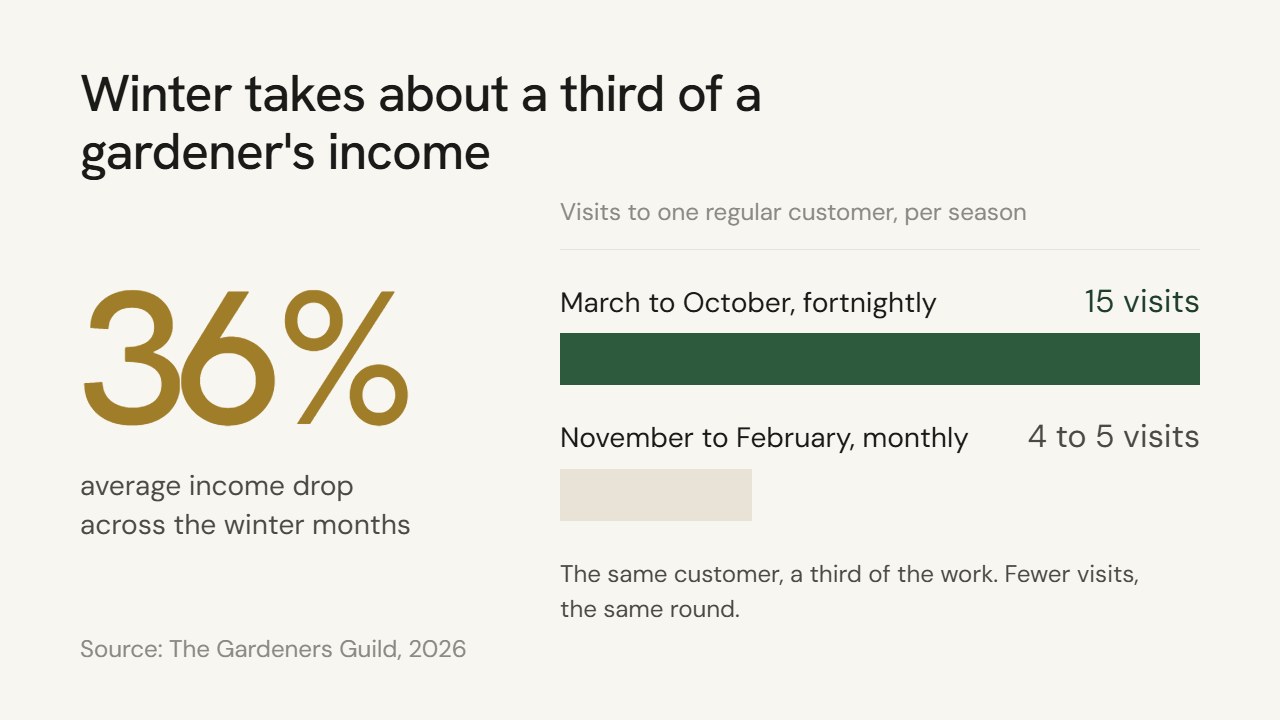
A self-employed gardener's income drops by about 36% on average over the winter months, according to the Gardeners Guild's 2026 cost guide. The gardeners who get through November to February without stress do three things: they price March to October knowing the quiet months are coming, they book winter work while customers are still thinking about their gardens, and they move a fixed share of every summer payment into a separate account before they can spend it.
Late August is the right time to set this up. You still have two or three months of full diaries. The decisions you make now decide what January looks like.
How big is the drop, really
The Gardeners Guild figure of 36% is the best published number. Protectivity puts it at up to 37%. The pattern underneath is simple: regular customers who want a fortnightly visit from March to October usually drop to monthly between November and February, so you go from roughly 15 visits to 4 or 5 per customer for the rest of the year.
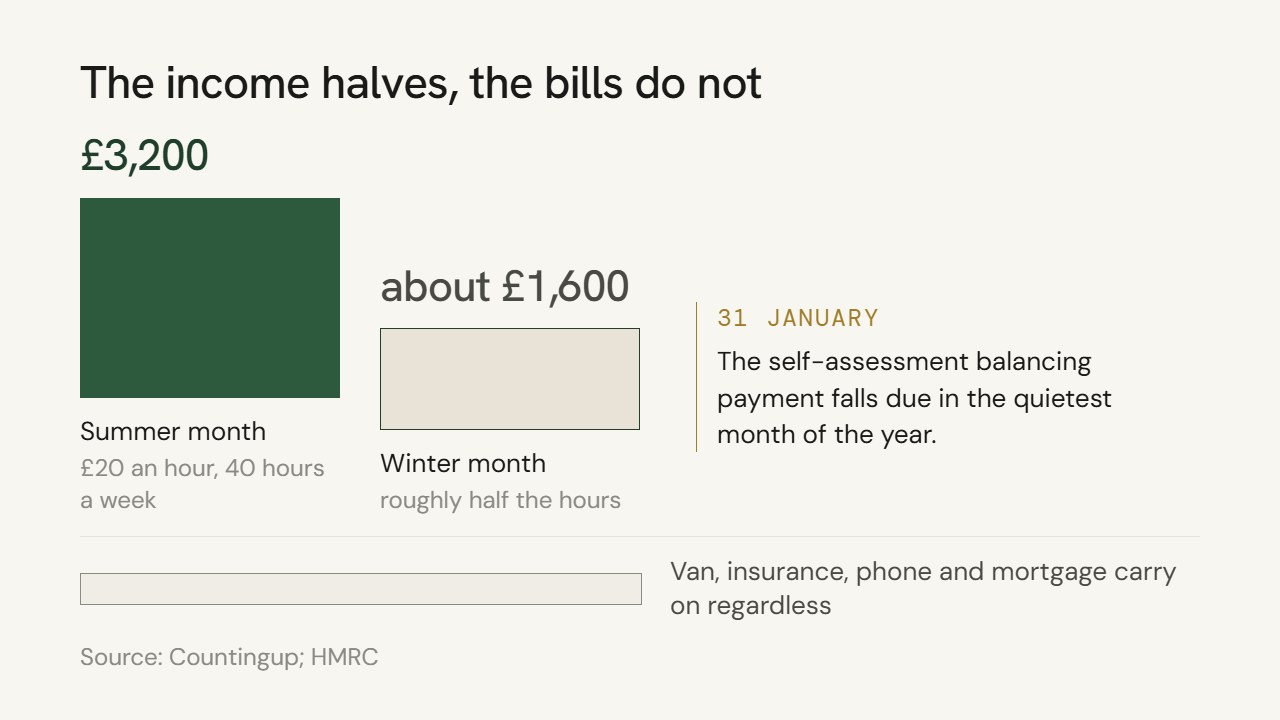
Countingup's worked example shows what that does to a month. A gardener charging £20 an hour for 40 hours a week brings in around £3,200 a month in summer. Halve the hours from November to February and it is £1,600. Your van, insurance, phone and mortgage do not halve with it.
And the worst-timed bill of the year lands in the middle of it. The self-assessment balance is due on 31 January, usually the quietest month you have.
Price the summer to carry the winter
The mistake is to set a day rate by looking at what the gardener down the road charges. Your rate has to cover the days you cannot work, not just the days you can.
MyJobQuote estimates that 251 weekdays a year shrink to roughly 180 working days once you take out holidays, sickness, weather and cancellations. The Gardeners Guild adds that around 23% of a gardener's turnover goes on business costs. So a day rate that covers your bills in June may not cover them across the year.
For reference, the Gardeners Guild's 2026 guide puts day rates at £210 for up to four years' experience, £272 for four to ten years and £343 for ten years or more, based on 7.5 chargeable hours. If you are well under those for your experience level, the winter dip is not your real problem. The summer rate is.
A practical way to check: take what you need to earn in a year, add your costs, and divide by 180, not 250. That is the day rate you actually need.
Book winter work in August and September
Customers are still in their gardens now. They will not be in December. Winter jobs are easier to sell while people can see the hedge that needs reducing.
Work that gardeners on the Landscape Juice Network routinely push into winter includes:
- Hedge reductions and renovation pruning, booked in summer for a winter date
- Apple tree, wisteria and vine pruning
- Leaf clearance on a fixed schedule through November
- Digging over borders, spreading compost and mulch
- Gutter clearing, fencing repairs and pressure washing in February
One approach from that thread is worth copying directly: keep a note of every winter job you spot while you are on a summer visit, then suggest it to the customer with a price before the season ends. A hedge reduction agreed in September for a January date is a day in January you do not have to find work for.
This is where most of the money leaks. You notice the job, mean to mention it, and forget by the time you have loaded the van. A quote you never send does not get accepted.
Offer the regulars a 12-month plan
A customer who pays the same amount every month for a year is the single biggest stabiliser a one-person gardening business can have. The Gardeners Guild notes that a gardener's lowest rate is often reserved for customers who give them work twelve months a year, and that is the right trade: a slightly lower rate for income you can rely on in February.
The shape of it is straightforward. Work out what the customer's garden needs across the year, say 16 fortnightly summer visits and 4 winter visits plus a hedge cut, price the whole lot, and divide by twelve. Yorkshire Lawn and Garden's 2026 figures put annual maintenance of a medium garden at £800 to £1,400, which is a monthly plan of roughly £65 to £115.
Not every customer will want it. Start with the three or four who have been with you longest. Even a handful of averaged plans takes the edge off the quiet months.
Set money aside from every summer payment
One gardener on the Landscape Juice thread described moving 20% of each month's earnings into a separate account, and said that in seven years self-employed he had never had to spend all of it over the winter.
Twenty per cent is a reasonable starting point for the winter buffer alone. If you are also saving for tax, it needs to be more, and it needs to be separate. The two pots do different jobs and mixing them is how people end up with a winter fund that is actually HMRC's.
The habit only works if it is automatic. A standing order the day after your usual payment day is better than a decision you make each month, because in September the decision always feels optional.
Use the quiet weeks on purpose
Winter is when the admin you have been putting off finally gets done: the tax return, the price review for next year, the list of customers you have not heard from. It is also the time to decide your prices for March, rather than quoting the first spring job at last year's rate because you did not think about it.
If you want that list kept for you through the season, 1pc for gardeners holds every quote, job and customer in one place, so the winter work you spotted in July is still there in October. It means nothing gets forgotten between the summer visit and the winter diary.